
Canang Sari in Bali: The Meaning Behind Bali's Daily Offerings
Published on , last updated on
Written by Emily Suryadi
Canang sari are the small daily offerings seen across Bali in temples, homes, shops, and streets. Made from woven palm leaves, flowers, incense, and symbolic elements, they express gratitude, devotion, and the Balinese Hindu philosophy of harmony between humans, nature, and the divine. Understanding canang helps visitors experience Bali with more cultural respect.
Overview
Step outside almost any building in Bali and you will find them; small woven trays of palm leaf, bright with flower petals, trailing a curl of incense smoke. They sit at doorsteps, temple gates, shop entrances, the dashboards of motorbikes, the corners of market stalls. They appear in the morning and are replenished throughout the day. By evening, many have been scattered by foot traffic or rain, but by the following morning, fresh ones have taken their place.
These are canang sari, and they are not decorations. They are sacred daily offerings, one of the most visible expressions of Balinese Hindu devotion, and one of the most misunderstood things visitors encounter on the island. This guide explains what canang sari are, what they mean, what goes into them, and how to move through Bali with the cultural awareness they deserve.
What Is Canang Sari?
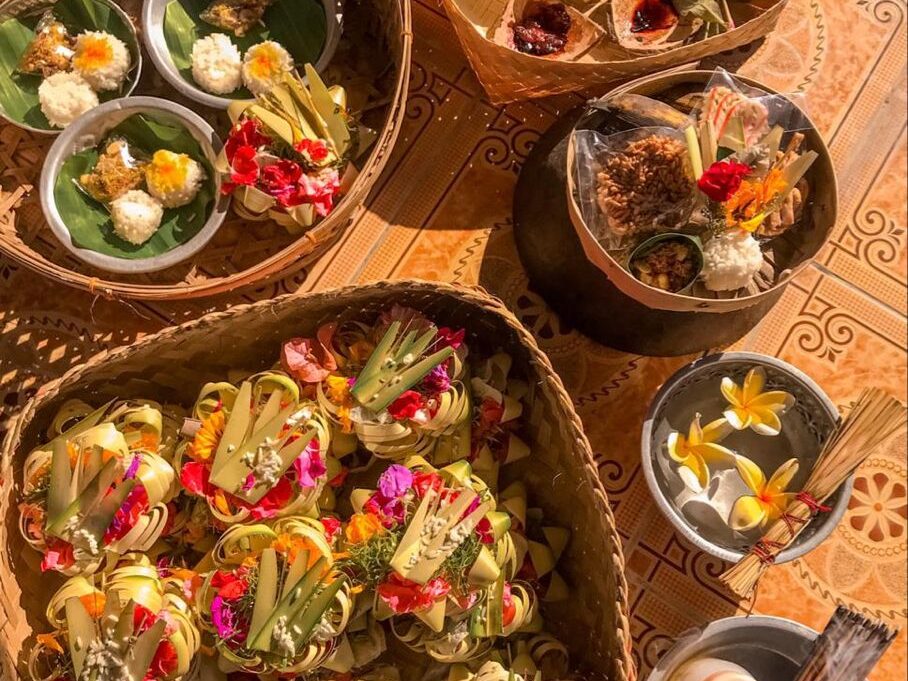
Canang sari is one of the most common daily offerings in Balinese Hinduism. The word canang is thought to derive from the Kawi language and relates to beauty and sacred purpose; sari translates broadly as essence. Together, the term describes an offering that carries the essence of devotion; something made with care and intention rather than material value.
Visitors encounter canang throughout Bali in a wide range of settings: at the entrance to family homes and compounds, on household shrines, at the threshold of shops and restaurants, in hotel lobbies and villa gardens, at beach access points, crossroads, and the base of large trees. They are placed wherever daily life happens, because in Bali, daily life and spiritual practice are not separated.
Why Canang Sari Matters in Balinese Culture
Canang sari is a daily expression of gratitude and devotion rooted in Balinese Hinduism, the form of Hindu practice that developed uniquely in Bali over many centuries. At its philosophical core is Tri Hita Karana, a principle that frames wellbeing as the product of harmony between three relationships: between humans and the divine, between humans and the natural world, and between humans and each other.
Canang sari enacts this philosophy in tangible form. The act of making and placing an offering acknowledges the divine forces present in everyday life, expresses gratitude for what has been received, and maintains the spiritual balance that Balinese culture understands as essential to both individual and communal wellbeing.
What canang sari represents, in brief: gratitude, balance, devotion, beauty, and continuity. It is not a petition or a transaction. It is an acknowledgment, made daily, that life is a gift requiring a response.
What Is Inside a Canang Sari?
The Palm-Leaf Tray
The base of a canang sari is a small tray woven from young coconut or palm leaves, folded and pinned with small bamboo slivers into a square or rectangular form. The tray itself represents human effort and sacred preparation; the act of making it is part of the offering, not merely a container for it. The skill of weaving palm leaves is passed through generations, typically from older women to younger family members, and the quality of the weave reflects the care given to the offering.
Flowers and Their Symbolism
Flowers are the most visually striking element of canang sari and are arranged with intention rather than placed at random. Different colors and types of flowers may be positioned to face specific cardinal directions, each associated with different deities or spiritual forces in the Balinese Hindu framework. White flowers are often placed to the east, red to the south, yellow to the west, and various other colors to the north and center. Practices vary by family, village, and the purpose of the specific offering, so this should be understood as a general orientation rather than a universal rule.
Incense, Rice, Coins, and Other Elements
| Component | Meaning | What Visitors May Notice |
| Incense | Carries prayer upward; purifies the space | The thin smoke rising from placed offerings |
| Rice | Sustenance; represents life and abundance | Small grains placed among the flowers |
| Coins or small money | Sincerity and material sacrifice | Visible in offerings at commercial premises |
| Sweets or food | Depends on purpose and location | More common in larger or ceremonial offerings |
| Holy water | Completes the offering when sprinkled | Used during prayer, not always visible in the offering itself |
Where You Will See Canang in Bali
Canang sari appear wherever Balinese people live, work, and move through the world. At home entrances and family temple shrines, offerings are placed to honor the household gods and ancestral spirits. At shops and restaurants, they acknowledge the divine presence in commercial life and express gratitude for livelihood. Hotels and villas place them at reception areas and gateways as part of daily spiritual practice, not as décor for guests.
On the street, canang appear at crossroads, considered spiritually significant intersections of forces; at the base of large trees, which are understood to house spiritual presence; and at beach access points where the land meets the sea. Vehicles, particularly those used for livelihood, often carry small offerings on the dashboard or front bumper. In more formal temple contexts, canang sari are part of larger offering arrangements called banten, assembled for ceremonies and placed on tiered offering stands.
One detail worth noting: offerings placed on the ground are still sacred. Their position does not reduce their significance. Stepping around them rather than over or on them is the appropriate response whenever possible.
The Daily Ritual: How Canang Is Made and Offered
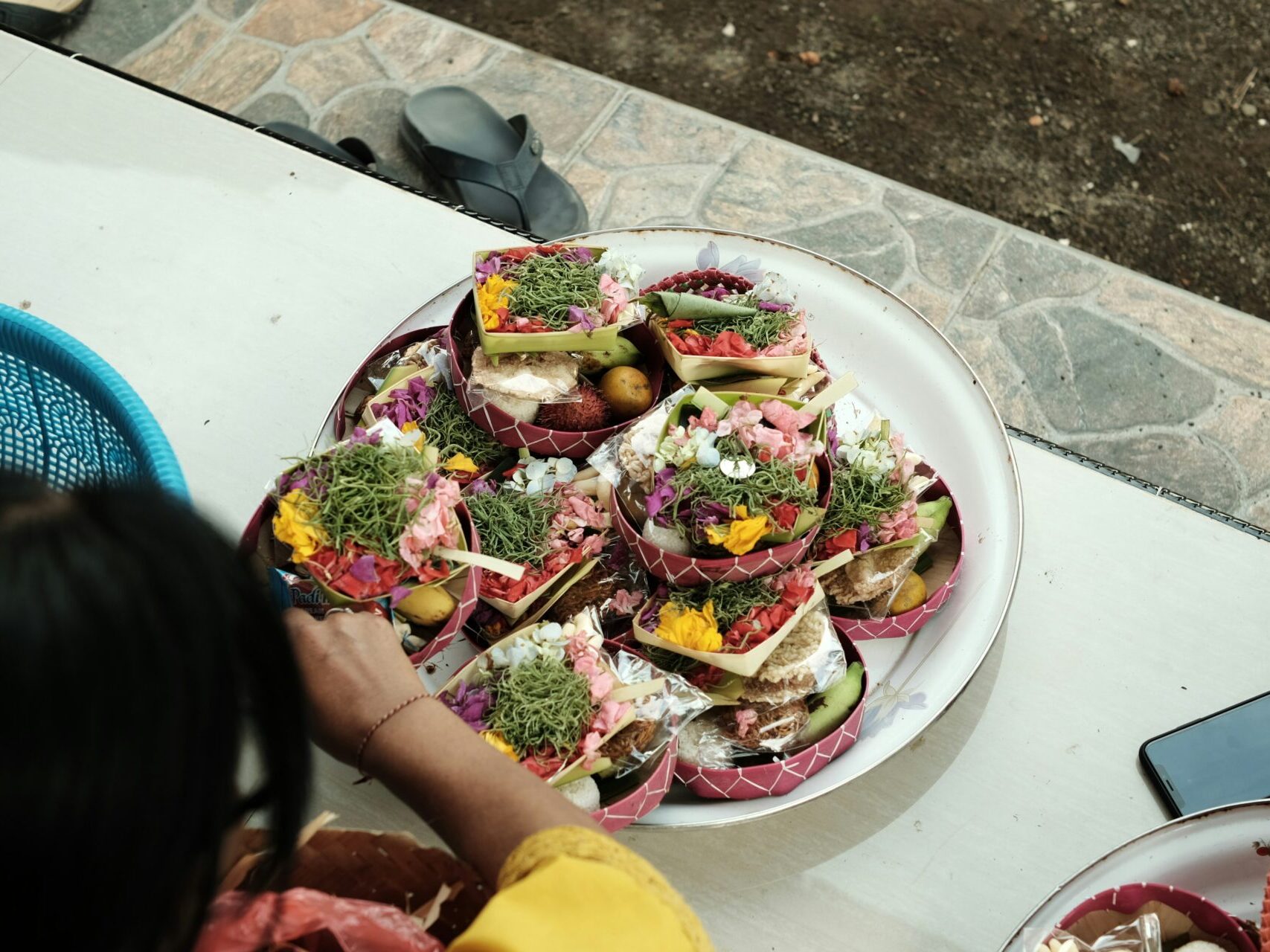
Canang sari is typically prepared in the morning, before the day's activities begin, though additional offerings may be placed at midday or in the evening depending on the household and occasion. The preparation itself, called metanding, is understood as a devotional act. The time given to making the offering carefully is part of its value.
Women most often prepare canang sari in Balinese households, though roles vary by family and context. The process generally follows this sequence:
- Prepare the palm-leaf tray by folding and pinning fresh leaves
- Arrange the symbolic base materials including rice
- Place flowers in their appropriate positions and colors
- Add incense, coins, or other elements as appropriate
- Place the offering at the designated location
- Pray and, where applicable, sprinkle the offering with holy water
The whole process may take a few minutes for a single offering; for a household making many offerings across multiple shrines and household locations each morning, it can take considerably longer. This daily investment of time and attention is itself the point.
Canang Sari and the Balinese Idea of Balance
Canang sari reflects a worldview in which the spiritual and the material are not separate domains. In Bali, the unseen forces that influence daily life, what might be described in other traditions as gods, ancestors, or spirits, are understood as present and active. Maintaining harmonious relationships with these forces is not a special occasion matter; it is a daily responsibility, as ordinary as cooking or cleaning.
Offerings placed high on shrines address divine or elevated spiritual forces. Offerings placed at ground level acknowledge the forces of the earth and the lower spiritual realm. Both are necessary; balance in the Balinese worldview requires attention to the full spectrum of spiritual relationships, not only those above.
Canang sari is a daily reminder that spirituality in Bali is lived, not only visited.
Tourist Etiquette: How to Respect Canang in Bali
Can You Step Over Canang?
Avoid stepping on or directly over fresh offerings whenever it can be helped. In busy streets and crowded markets, this is not always possible, and Balinese people understand that accidents happen. The intention is what matters; making a visible effort to move around offerings rather than walking straight through them is noticed and appreciated. If you accidentally step on one, do not make a scene; continue respectfully and be more careful going forward.
Can You Photograph Canang?
Generally yes, and canang sari make for genuinely beautiful photographs. The relevant boundaries are around interruption and instrumentalization. Do not move an offering to get a better angle. Do not photograph during active prayer or ceremony unless you are certain that is acceptable in that specific context. Treat the offering as what it is rather than as a prop arranged for your image.
What Should Visitors Avoid?
- Kicking, moving, or touching offerings unnecessarily
- Posing with temple offerings in ways that mock or trivialize them
- Walking through a freshly laid line of offerings without acknowledgment
- Wearing immodest clothing near temples or during ceremonies
- Treating the smoke or incense as a nuisance rather than as part of a devotional act
Common Misunderstandings About Canang
| Misunderstanding | Better Explanation |
| They are decorations | They are sacred daily offerings with specific spiritual purpose |
| All canang are the same | Offerings vary by purpose, household, village tradition, and ceremony |
| Accidentally stepping on one is a serious offense | Accidents happen; respectful awareness is what matters |
| They are only found in temples | Canang appear wherever Balinese daily life takes place |
Why Canang Is One of the Best Ways to Understand Bali
More than any single landmark or cultural performance, canang sari reveals how Bali actually works. Spirituality here is not compartmentalized into temples and festivals; it is woven through every morning, every threshold, every transaction, every journey. The offering outside the convenience store and the one at the gate of a thousand-year-old temple are part of the same practice, scaled differently but identical in intent.
Understanding canang asks visitors to make a small but meaningful shift; from observing Bali as a backdrop to recognizing it as a living culture with its own logic, values, and daily commitments. The person kneeling at the entrance to their shop each morning is not performing for tourism. They are doing what they have always done, and what their parents and grandparents did before them. Acknowledging that, even in passing, is one of the most genuine forms of cultural respect available to a visitor.
FAQ
What does canang sari mean in Bali?
Canang sari translates broadly as the essence of a sacred offering. Canang is thought to derive from a Kawi language term related to beauty and sacred purpose, while sari means essence. Together the term describes a daily devotional offering that carries the intention and gratitude of the person making it rather than material value.
Why do Balinese people make offerings every day?
Daily offerings reflect the Balinese Hindu understanding that spiritual relationships require daily maintenance, not occasional attention. Canang sari acknowledges the divine forces present in everyday life, expresses gratitude for what has been received, and upholds Tri Hita Karana; the principle of harmony between humans, the divine, and nature.
What are canang sari made of?
A canang sari is built on a base tray woven from young coconut or palm leaves, then filled with flowers arranged by color and direction, incense, rice, coins, and sometimes sweets or food. The specific contents vary by family tradition, village practice, and the purpose of the offering.
Is it disrespectful to step on canang?
Deliberately stepping on or kicking offerings is disrespectful. Accidental contact in a busy street is understood to happen. The appropriate response is to make a visible effort to walk around offerings and to be more aware going forward.
Are canang sari only found in temples?
No. Canang appear at home entrances, family shrines, shops, restaurants, hotels, vehicles, crossroads, beaches, large trees, and any other location where Balinese people live and work. Their presence in temples is more formal and elaborate, but the daily offering practice extends through the full range of everyday life.
What is the difference between canang and banten?
Canang sari is a specific type of daily offering; relatively simple and made for everyday devotion. Banten is a broader term for the full range of offering arrangements in Balinese Hinduism, including much more elaborate assemblies prepared for ceremonies, temple festivals, and significant life events. Canang sari is one component within the wider practice of banten.
Why are offerings placed on the ground?
Ground-level offerings acknowledge the spiritual forces associated with the earth and the lower spiritual realm. In the Balinese worldview, maintaining balance requires attending to the full range of spiritual relationships, not only those above. The placement is intentional and carries its own significance.
Can tourists learn to make canang sari?
Yes. A number of cultural programs, temples, and community tourism initiatives in Bali offer canang-making workshops where visitors can learn the practice from local women in a respectful and appropriate context. This is widely considered one of the more meaningful cultural activities available to visitors.
What should I do if I accidentally step on an offering?
Do not panic or make a scene. Move on respectfully, be more mindful going forward, and do not attempt to fix or rearrange the offering. Balinese people understand that visitors navigating unfamiliar streets will occasionally have accidents; the intention behind your behavior is what is most visible.
Categories: About Bali, Art & Culture, Traditions

Emily Suryadi
Hello! I'm Emily, born and raised here in Bali. I'm all about exploring the hidden charms around the island I call home. From trendy spots, hidden corners, to a stretch of idyllic sand where sunsets seem to stretch on forever. Trust me, there's no shortage of eye-opening destinations once you touchdown in Bali.